
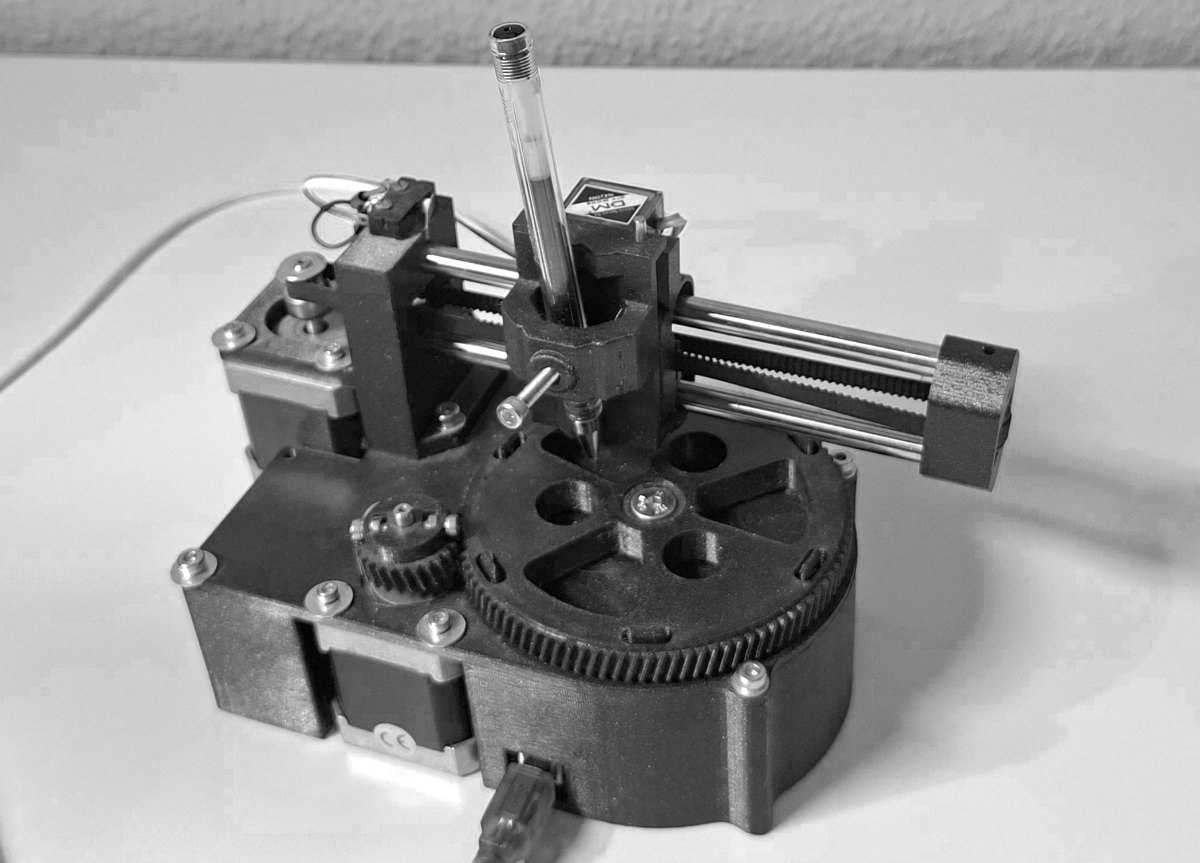
In front of my table there was a crowd of people, and almost nobody paid attention to me – everyone was watching a beer coaster that turned slowly while a ballpoint pen drew ring after ring on it. After about five minutes you could recognize a face, namely the face of the person standing right at the front.
This was at the end of September at the Hamburg Artists Art Market (HAAM), which took place for the fourth time this year in the Kraftwerk Bille, a former power station in Hamburg. The machine on my table is called Peppo (short for Pen Polar Plotter), and it took almost exactly eight years until it could stand there.
I first saw the idea at the end of 2018 on Hackaday, a big blog for DIY and electronics projects: the Polar Coaster by Bart Dring, a small drawing machine for drink coasters. The principle is actually simple – the beer coaster lies on a turntable, and the pen moves on a slide from the center to the outside. So instead of left-right and forward-back like a normal plotter, the machine works with two other values: how far the turntable has rotated and how far the pen is from the center (mathematicians call this polar coordinates).
I wanted one immediately, but not as a replacement for the Rolands, more as a counterpart to them. The big vintage machines live in the studio, and they stay there. With small DIY machines, something else fascinates me: you can take them with you, and they make it very easy to start a conversation with people.
On top of that, a polar plotter moves differently than a classic one that drives on two straight axes, and in the end you can see this in the lines. And beer coasters are easy to find – for small sketches and fun pictures I think the format is almost ideal.
What I was missing, though, was a 3D printer and any experience with hardware. So for the moment it stayed a wish (if you read my first post, you know the pattern).
In 2024 I met Barozzi (@barozz.it), who shared my fascination for pen plotters and had exactly the equipment and technical skills I was missing – at that time he had even developed his own plotter already. Suddenly the situation looked completely different.
As a base we took a remix of the Polar Coaster by kubino, which is a modified version of the original that someone shared online for free so others can build it. Instead of the original control chip it uses an Arduino (more on this in a moment), plus stronger motors and more stable guide rods. We discussed the design decisions together, then Barozzi took care of the 3D printing and the assembly, while I wrote the first software.
From the beginning the goal was a setup that is as mobile as possible, so you can make live portraits in a bar – that's why the beer coasters, of course. This means everything runs on battery, and not only the plotter itself but also the control has to be mobile. In the end it looks like this:
- Inside the plotter there is an Arduino, a small and simple microcontroller, with an add-on board for the motors (a so-called CNC shield). It runs GRBL, a widely used software that translates movement commands into single motor steps.
- A Raspberry Pi, a complete mini computer about the size of a cigarette pack, creates its own Wi-Fi network that you join with your phone. It serves the control page, which you then use in a normal browser, and sends the drawing commands to the Arduino (G-code, basically a long list of instructions like “move here, pen down, move there”).
- With the phone you take a photo, which is converted directly into pen paths, meaning the lines the pen will follow later. These go to the Pi, and the Pi plots them.
- As pens I use completely normal ballpoint pens or ink pens.
- The power comes from a power bank.
For the portraits I used my tree ring algorithm, because it fit the machine best: the rings follow the rotation of the plotter quite naturally instead of working against it. I will explain how exactly it works in a separate post – I use it in modified form for many projects anyway.
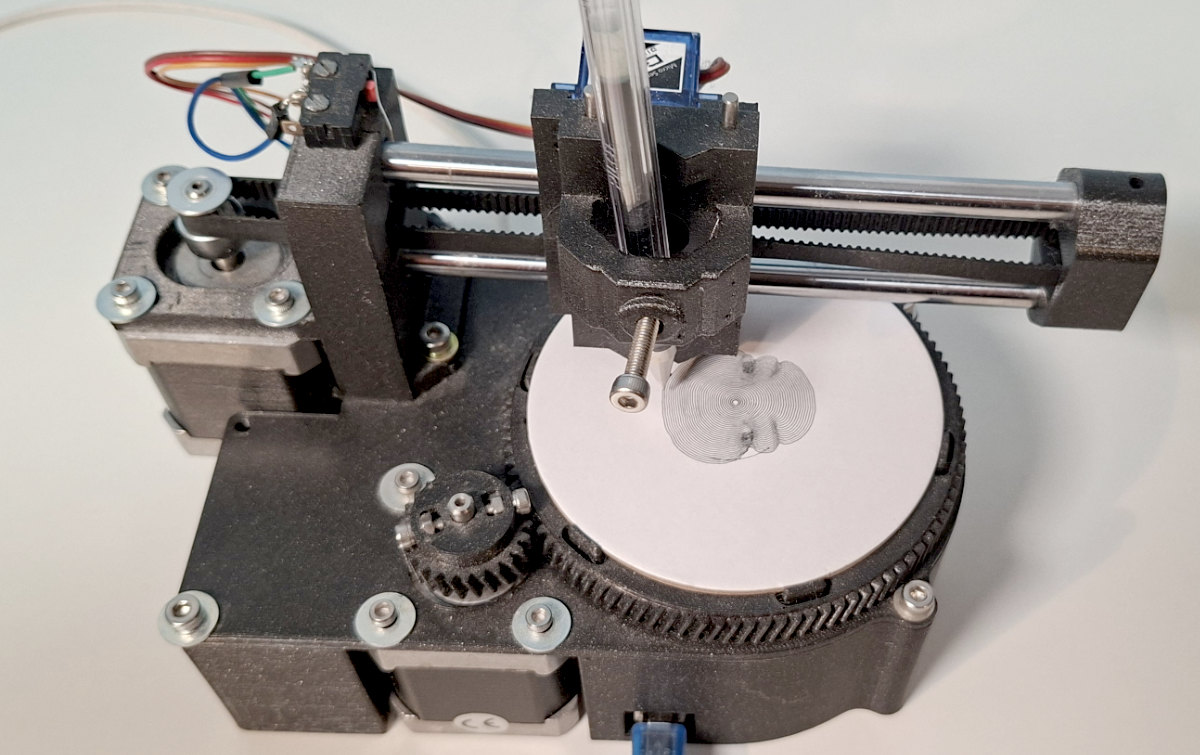
After that I often had Peppo with me when I visited friends, and this was actually the real testing phase – a lot of plots, a lot of feedback and many small bugs.
I mainly learned two things. The first one: kids can spend hours with the machine, take a photo, watch, next photo.
The second one was a bit more uncomfortable: as soon as you use something more often, a good and simple user interface is extremely important. With my own algorithms I usually don't give this enough time, because of course I know what every parameter does, and I know every config file with all its settings.
At least until I come back after a break of half a year and have the feeling that starting completely from scratch would be easier than learning everything again. That's exactly what happened, and the project was on hold for a while.
I only got myself going again for the HAAM. I reworked the code and made it more robust, and above all I simplified and unified the controls to the point where I can use Peppo reliably in live operation while I talk to visitors, instead of looking at my phone all the time.
And it really worked. I drew portraits of visitors live and gave them away, answered questions, explained the principle, talked shop and also discussed where else something like this could be used – portraits of the guests at a wedding for example, or as a personal souvenir at a trade fair, where you then have five minutes for a conversation on the side (that's about how long a plot takes).
Afterwards I started to post pictures of Peppo on Instagram, and there too the feedback was much bigger than I expected. It almost seems like many people were waiting for exactly something like this.
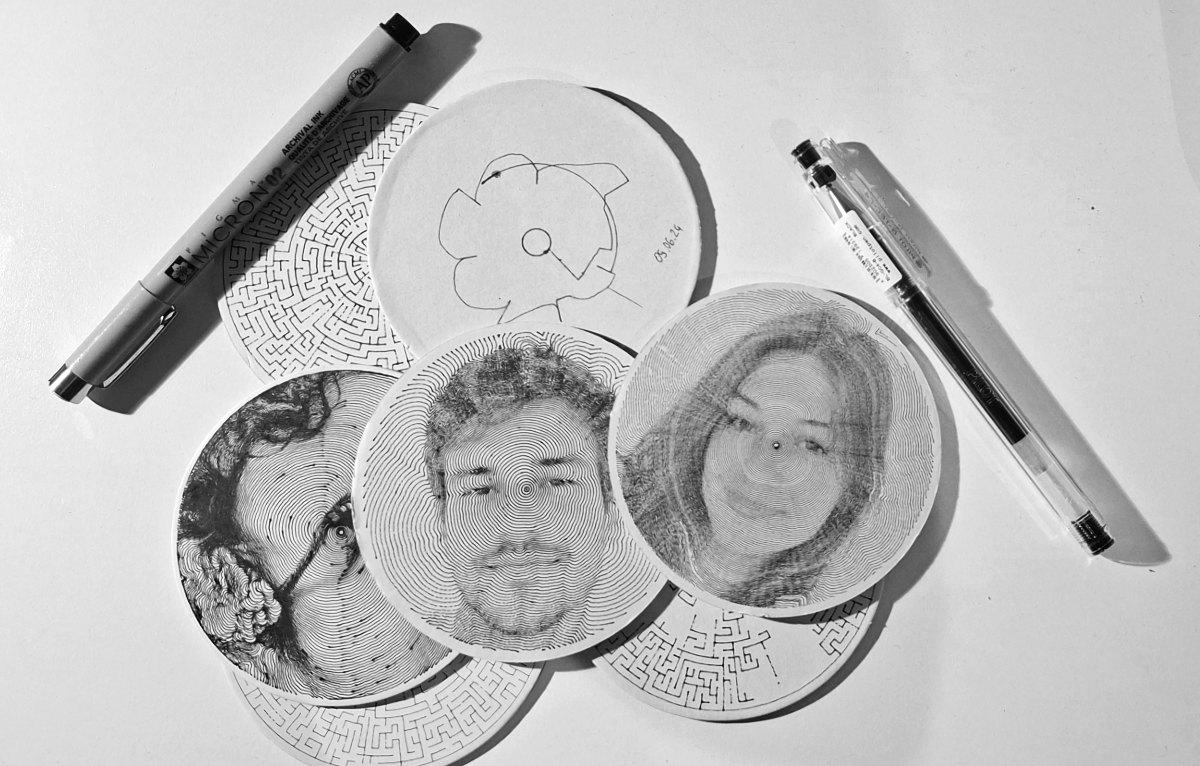
I think by now I also understand why. In the end Peppo is a simple machine where you see immediately how it works, and it does a task that is easy to understand. You can already guess the next movement, and still you enjoy every time how consistently and precisely it does it.
So I will definitely exhibit Peppo more often and also share pictures on Instagram more regularly – because new ideas only come when you spend more time with a topic, whether for more algorithms that make sense in polar coordinates or for new technical possibilities.
A version 2 is already being planned: with a bigger drawing area and a movable height axis for the pen. At the moment Peppo can only put the pen down or lift it, in the future it should be able to move it continuously, which makes it possible to control the pen pressure, for example. And everything in a compact housing – this time not a remix, but developed completely from scratch.
More on this as soon as there is something to show.